Saturday, August 27, 2022

Free Science Journal: Sun, Earth and Moon

 Free Science Journal #10

System of the Earth, Sun and Moon

Welcome to another fun-filled freebie science journal!
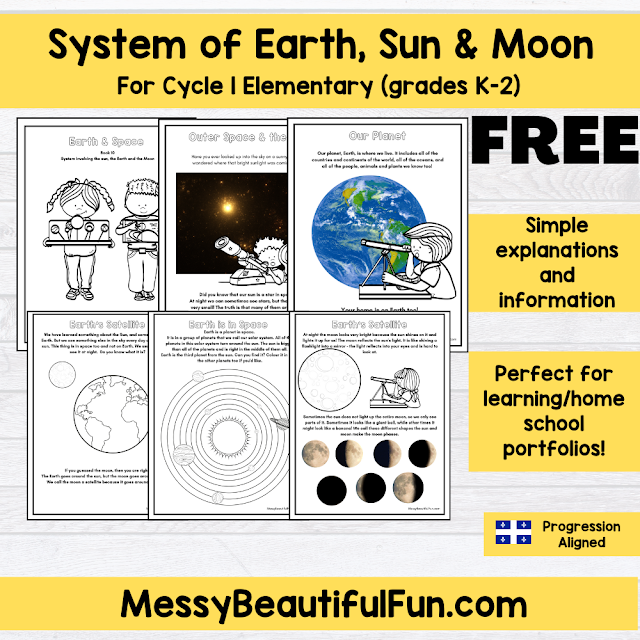
This one is all about the system involving the sun, the Earth and the moon and is made especially to cover the progression of learning "Associates the sun with the idea of a star, the Earth with the idea of a planet, and the moon with the idea of a natural satellite"

It is made especially for K-2 but can be used for any age or grade level that you see fit!
Have you seen out other science journals? Check them out HERE

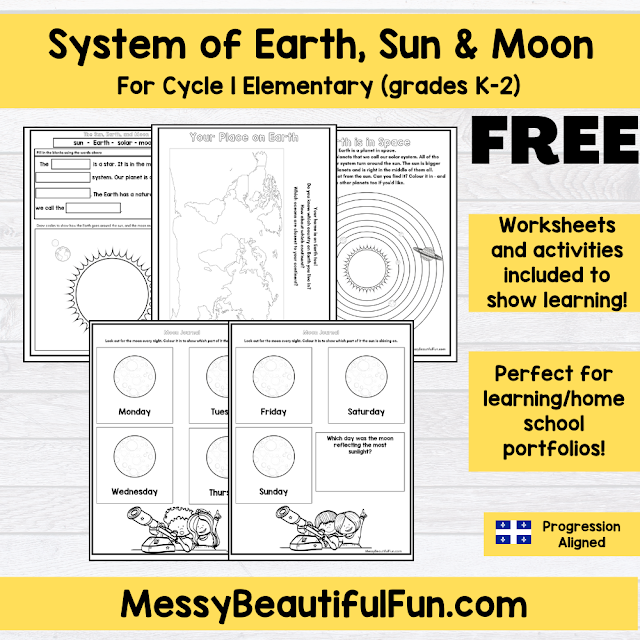
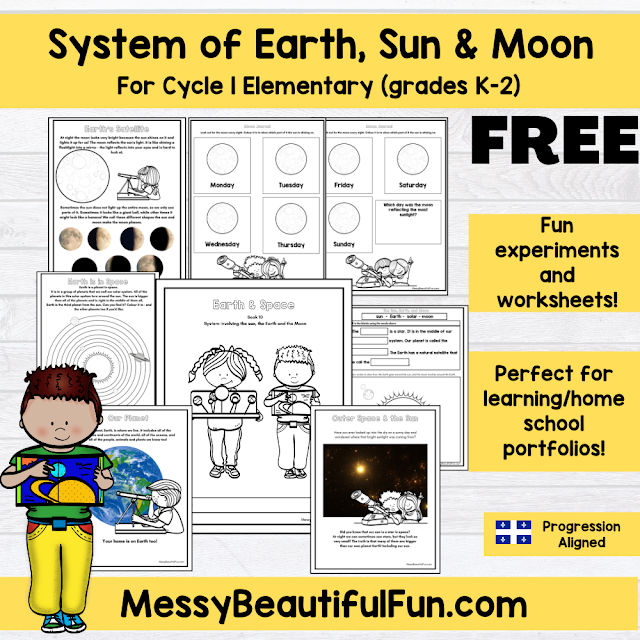
This science journal gives simple information showing students how the sun, Earth and moon all relate to each other. It explains that the sun is a star, and the Earth exists in a  solar system and revolves around the sun. and the moon is a natural satellite that revolves around Earth and is lit by reflecting the sun's light.

It includes some fun activities!
I have included a basic worksheet in this journal along with pages to colour in and label. It also includes a fun moon journal that kids can keep for a week to see how the suns light changes position on the moon. It is a very simple explanation for this age group, and doesn't contain specific moon phases - that will be covered in an upcoming journal for older grades.

You could, of course, add in a book if this is something your child is very interested in and learn all about the moon phases together. That is my hope with these easy-to-use journals is that they inspire some further learning!

You can download this freebie below!
Also, if you are a Quebec homeschooler, be sure to check out my QC-aligned Science page here!


Free Science Journal: Shadows


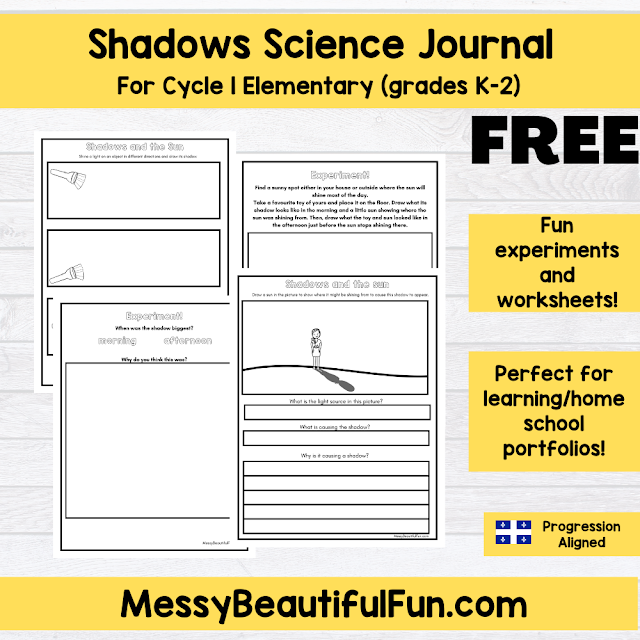
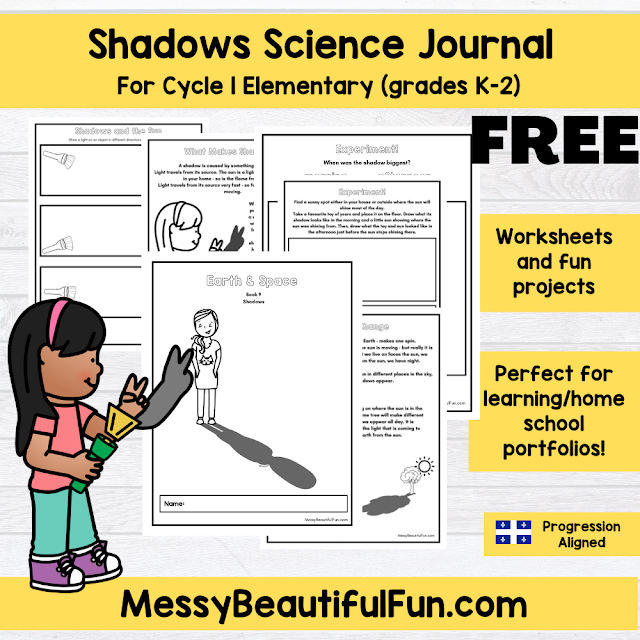
I don't think there is one kid who hasn't stopped to play with their shadow at some point in the day. Whether they have been making shadow puppets with their hands or trying to escape their shadow like Peter Pan, kids naturally love to experiment with light and shadow.

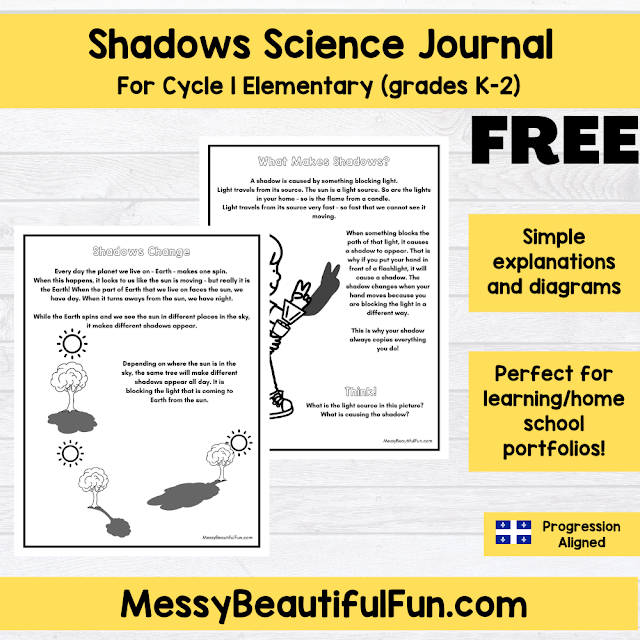
This science journal is one great way to show that learning in either a homeschool setting or classroom/co-op. It explains light sources and how shadows are made in simple terms for grades k-2. It also covers the progression of learning (in Quebec) for Earth and Space, Systems and Interactions, "Describes the apparent position of the sun on the length of shadows"


But whether or not you're teaching these specific progressions, most curriculum and guidelines do include children learning about the simple concepts behind light and shadows in grades k-2. Of course, you could also use this unit with older children who have never studied this concept before, or with mixed ages.


This journal also includes some great worksheets and experiments to show your kids learning for portfolios or reporting, or just for fun memories!

I hope that you and your learners enjoy this journal - have you seen the rest of the collection HERE? We have so many now and more on the way! Download this one below...


Saturday, August 20, 2022

Free French Verb Unit 1: Voir

 Free French Verb Book Unit Voir

For beginner learners

If you're teaching French to either your own kids or a classroom full of learners, then you know how difficult it can be to find just the right resource to teach different verbs. Some are SO full of information they can be too much for new learners. Others include only the verb conjugated on a sheet and no real-world connection. That is what I am hoping to avoid with my own kids by creating these units.

I started with the verb 'voir'/to see because it is a verb that most kids use every day. It can also be used any time, anywhere - what do you see? You can ask it on a nature walk, in a classroom, looking out the window, or on a long bus ride. 

This unit teaches learners to conjugate the verb voir in the present tense, as in something that is happening right at the moment it is said. 

For example, the first page of the book starts with 'Je vois un chat' (I see a cat)

The next page continues with 'Tu voit une abeille' (You see a bee)

It goes through every person (je, tu, il, elle, nous, vous, ils, elles) and includes a nice, big colour photo to illustrate the phrase.

It also comes with these little cards to print out and use to practice saying the verb, memorizing it, or to use it in a sentence. As you and your learners learn more verbs, you can mix these up and practice making plenty of sentences in French.

The last part of this unit includes some worksheets for different levels of learners. there is a very simple page where kids can draw a picture of what they see and maybe write a label on it. There is a more detailed one where they have space to draw and write. 

Finally, there are 2 conjugation pages - one asking them to conjugate 'voir' in the present tense, use it in a sentence, and illustrate a picture. the second conjugation page has a blank space so that you can have them practice other tenses if you'd like.

You can download this freebie below. All I ask is that when sharing this resource, please share the link to this page and not the google drive. Thank you and enjoy!


Download The Free French Voir Unit Here

Wednesday, August 17, 2022

Free Science Journal 8: Precipitation

Free Precipitation Weather Science Journal

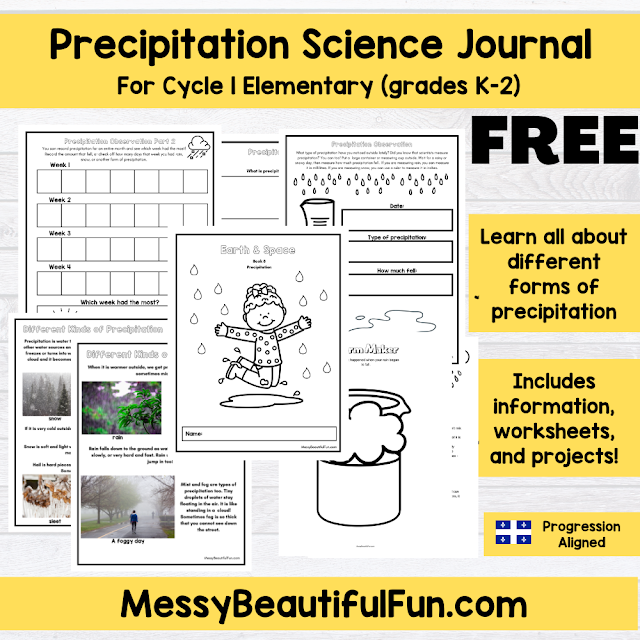
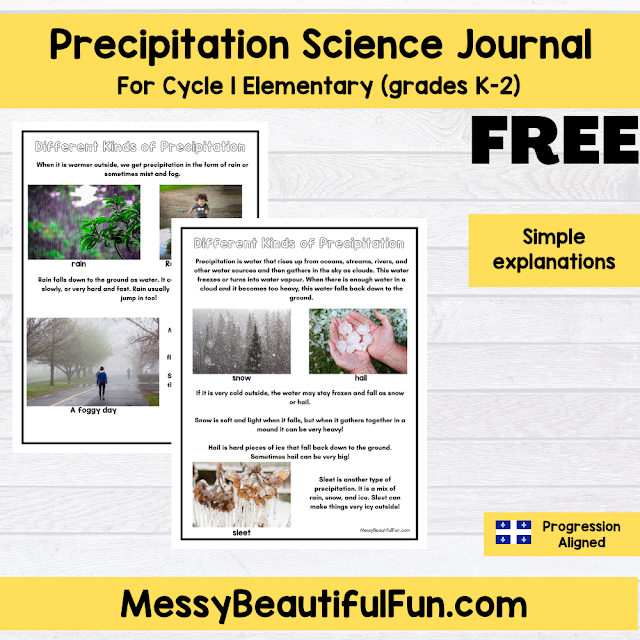
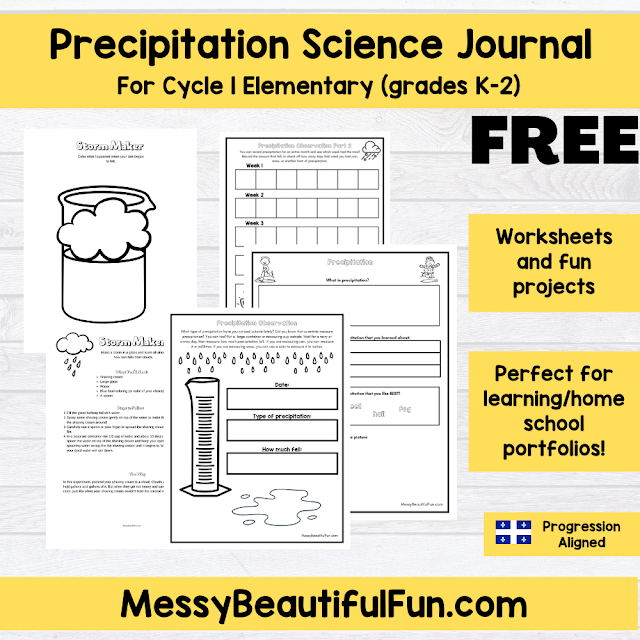
Rainy days jumping in puddles, snowy days rolling snowballs, and foggy days spent wandering the streets as explorers - what do all of these have in common? They all deal with different types of precipitation!

Learning about different types of precipitation is an important scientific concept, especially for kids in grades k through 2. This free science journal goes over all the basics and includes fun projects to help show students learning too!

If there is one subject that I know my kids always love to cover in science it is weather. It is something we deal with on a daily basis, so learning about and experimenting with weather always feels familiar and fun.

This precipitation unit talks about different types of precipitation and explains what the word means. It also includes a simple worksheet and 2 fun projects that kids can do to show what they have learned.

The first project includes 2 optional parts. First, learners will leave a container outside and measure precipitation for a day. Next, learners can measure precipitation (rain or snow, etc) over one month or just check off days that there was rain, snow, hail, etc. They can then award a 'winning week' - whichever week had the most precipitation.

I hope that you and your learners love this one! It covers the Quebec progression of learning for Science and Technology (Earth and Space) that states "Describes different types of precipitation (rain, snow, hail)"
But of course, it can be used by any age group anywhere in the world!

Download this science unit for free below!
All I ask is that if you would like to share it, please link to this blog page or post. Thank you!

Sunday, August 14, 2022

Free Science Journal: Water in my World

 Free Science Journal Water Sources

Water is something that is so important for us and all of the other living things on our planet. That's why it's so important for us to teach our kids about what a precious resource it is and exactly where it comes from. Getting water from the tap or a bottle is something many of us take for granted, and our children might too. I know I do! Showing kids that the water we have in our homes comes from a freshwater source can help them understand more about our world and make them great stewards of the lovely water we have.

This science journal was made with cycle 1 kiddos in mind (grades 1-2), but of course, it can be used by any age group! It covers the progression of learning "Identifies natural sources of water (brooks, lakes, rivers) and natural sources of salt water (seas, oceans). Depending on where you live in the world, that might be worded differently in your curriculum requirements, but most elementary science curriculums do require kids to know about water sources.

There are some simple worksheets in this science journal to help cover the basics - and there is also a really fun project! Kids will learn about saltwater sources, freshwater sources, and man-made water sources.

As in all of my other free science journals, I have included simple explanations. If you find your kiddos really interested in a topic, feel free to slow down and explore it further with youtube videos, library books, and other units too! 

To download this free science journal, click the link below the image:

*Please feel free to share this freebie, but please share the link to this page or my blog, NOT the Google Drive link. Thank you!*


Download Water Sources Science Journal Here


Tuesday, August 9, 2022

Free French Verbs Book and Unit

 Free Printable French Verbs and Writing Sheets

Are you hoping to help your child learn to speak or write in French this year? Then I have got some GREAT French units for you - and more coming too! You can see all of the units on my French units freebies page here!

Verbs are an important part of language - no matter which you are speaking! Learning the verbs in their infinitive form (stem form) is an important first step in language learning for sure. Once you know the base word, it makes it simpler to conjugate later on.

That is exactly why I made this unit for my own kids - and am now sharing it with you!


One of the best (and most fun!) ways we practice French in our homeschool is by learning new words every week - verbs, adjectives, and nouns. We learn what they mean in English, then string them together into sentences that make sense. From there, we conjugate the verbs into the tenses we want and I let my kids choose their favourite sentence and draw a picture of it in their notebooks.

We re-read these sentences all the time (they get pretty silly!) and have a lot of fun doing this - and I hope that you can too!

--pictures coming soon of how we use this unit in our homeschool--


I have included everything a beginner French learner will need in this unit to build a sentence using these verbs. (coming soon - adjective and noun units!)

-Conjugation charts and some quick tips on how to conjugate

-Verb cards in full colour in all 3 groups (-er, -ir, -re)

-Writing pages to practice writing some sentences with simple prompts (ex: What are you doing?)

-Translation Guide


I hope that this unit makes teaching easier for you and your learners! 

Stay tuned for more French units coming soon.

Download this freebie below...


Download French Verbs Unit Here

Love this unit? Check these out too!


Friday, August 5, 2022

Free Science Journal: Everyday Technology

 Free Printable Science Journal
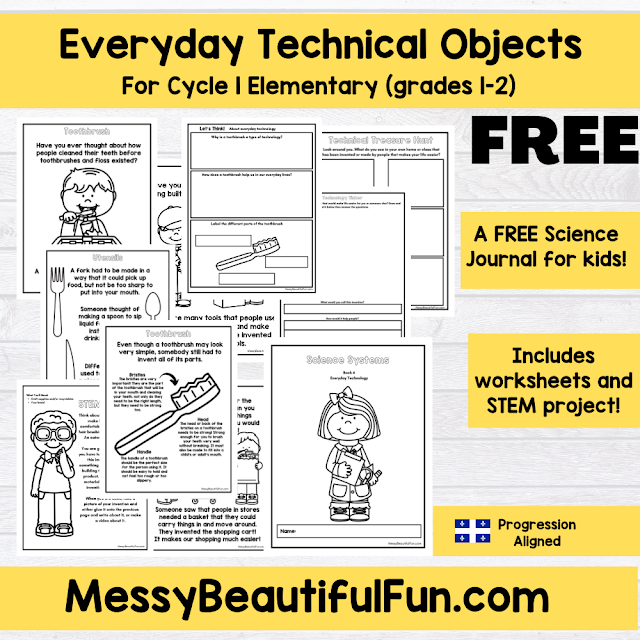
Everyday Technical Objects

When we think about technology nowadays, most of us tend to think of electronics. Computers, smartphones, tablets, TVs, and smart technology has taken the forefront of that topic! But have you ever sat down and thought about who invented a shopping cart and what going to the store was like before they had them? Or have you ever brushed your teeth at night and wondered how different life would be if we still only swished water around our mouths to clean them? (yuck!)

Small inventions like these are still pieces of technology, but oftentimes we don't give them much thought. They're just there and part of life. But long ago, someone thought of these things. They thought of these things to make life easier, more comfortable, and healthier. 

Pointing these things out to our kids is not only fun but can get their own wheels turning. What could they make that could make life easier? How do inventors invent these things? How would my life be without a spoon?


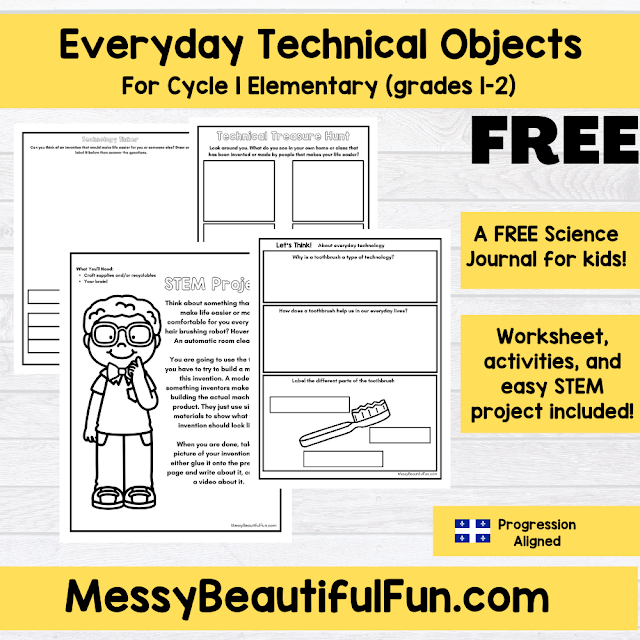
This unit was made to cover the progression of learning in grades 1-2 that covers the topic of Systems and Interaction - Everyday technical objects. But I think it is such a fun topic to explore with our learners! I honestly can't wait to explore this one with my own kids. I can see us spending plenty of time with a few books on inventions and videos on who invented what :)

Like my other science journals, this one is free! Although it is aimed at the progression of first and second grade, feel free to use it with learners of any age. I will be with my 8 and 11-year-olds. 

As always I have included some worksheets to show their learning, but have also included a fun project and a writing page where kids are encouraged to think of their own 'everyday' inventions.

You can download this unit for free below...


Download The Free Science Journal HERE

*Please do share this resource! All I ask is that you share the link to THIS blog or post, not the google link.*